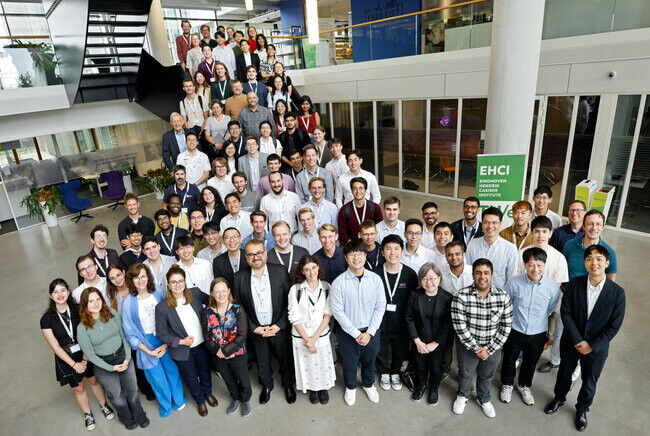
Participants at the ESSS of last year. Photo: Bart van Overbeeke.
ESSS2025 offers students an exceptional insight into all’aspects of the semicon ecosystem.
Next week eighty students, from twelve countries, will come together to immerse themselves in the world of semiconductor R&D and technology at the annual Eindhoven Semicon Summer School (ESSS), now in its third edition. This prestigious program for worldwide top talent covers the full semicon value chain - from equipment and devices to circuits, systems and applications. The ESSS is organized by Eindhoven University of Technology (TU/e) together with key partners ASML, NXP, ASM, TSMC and SmartPhotonics.
Support from semicon universities and companies
During the 6-day program, which is unique worldwide, the students will learn about the latest developments, trends and challenges from thought-leaders and top specialists from leading semicon organizations: TU/e, ASML, NXP, ASM, KU Leuven, imec, IBM, TSMC, Smart Photonics, Synopsys, EFFECT Photonics and Axelera AI.
International network
By bringing the ESSS students into contact with a wide range of professors and top experts from industry, and with each other, the ESSS cultivates a salient international semicon community, a growing network to continue collaboration. The ESSS participants are both bachelor and master-level students from universities in the Netherlands, Taiwan, Vietnam, Thailand, Japan, Malaysia, USA, Lithuania, Romania, Italy, Spain and Germany.
The program takes place at three semicon hotspots: at TU/e, at the ASML campus in Veldhoven and at the NXP facilities in Nijmegen. Throughout the week, students will work on team projects supervised by industry leaders, making it truly an international and enriching experience. They will present their solutions at the end of the week before a jury of academic and industry experts.
Have a look at the recap video of the ESSS2024 here.
The very best
The ESSS aims to attract the very best talent to the Brainport region, one of Europe’s strongest semicon and photonics regions. With the program the organizing parties are keen to contribute to the goals of the European Chips Act, the European Semicon Coalition but also the needs of the semiconductor ecosystem. The EU and its Member States are investing heavily in semicon, as it boosts economic development, scientific advancement and industrial competitiveness.
Talent is crucial
Silvia Lenaerts, rector magnificus of TU/e: "Semicon technology is essential for any country’s progress. But the semicon sector also is one of the most complex, knowledge-intensive and globalized sectors. It makes global talent the crucial necessity for this sector. That is why we are organizing this summer school. We want to educate and stimulate talent and help them with their network creation. And of course we also want to attract top talent to the unique semicon and photonics ecosystem of the Brainport region and to TU/e’s semicon master’s courses. We are currently in the process of almost doubling the number of semicon master’s students at TU/e, and next month we will launch our new institute on semicon and hightech. We are fully committed to boosting the Brainport semicon ecosystem and to bolstering Dutch and European technological sovereignty."
A firsthand look
Roger Dassen, CFO of ASML: "We are again very excited to open our doors for students to visit ASML during the ESSS. It offers students a firsthand look at the semicon sector that it is not only a dynamic place, but also essential to shaping the technologies of tomorrow. As the demand for semiconductors continues to grow, so too does the need for skilled talent. We are committed to investing in skilled talent to meet the growing demand for future expertise in the semiconductor industry."
Strong legacy
"The Netherlands is a powerhouse in semiconductor technology, and the Brainport region is a key semicon epicenter in the Netherlands, with a dynamic and broad semicon ecosystem", says ESSS Scientific Director professor Aida Todri-Sanial. "At the center of this ecosystem is TU/e, with its strong legacy in semiconductor research. That makes our region an ideal location for this program. I am convinced that we are offering the students an exceptional insight into all’aspects of the semicon ecosystem; equipment, materials, processes, devices, circuit system design and applications. It’s a one-stop shop for starting on semiconductor studies, which will greatly help them with their career."
A growing ESSS community
This year sees the third edition of the ESSS. The number of students has grown from 60 last year to 80 this year and the number of partner universities has grown from 16 to over twenty. The aim is to eventually attract 100 top students each year, with a world class semicon program, and a thriving and growing global semicon community. The ESSS is co-funded by the National Reinforcement Plan for Microchip Talent, the ’Beethoven’ talent plan.