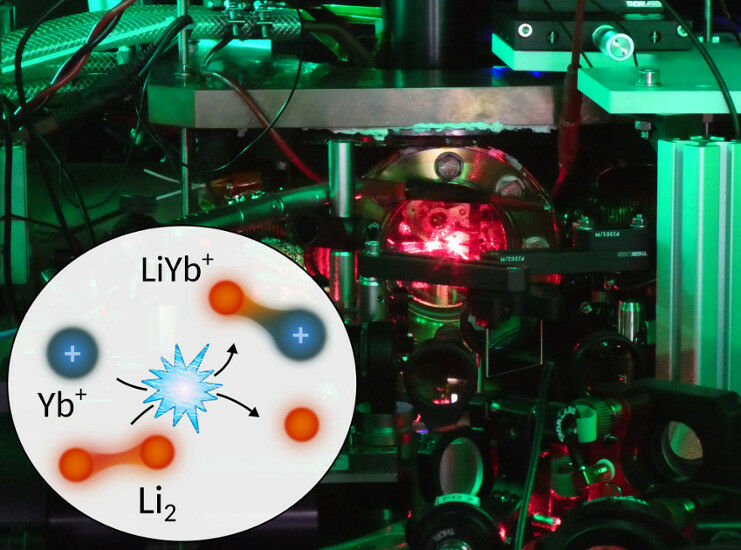
Drawing of the studied collision between an Yb ion and a Li2 Feshbach molecule, resulting in a LiYb+ molecular ion. The background shows a view of the hybrid ion-atom experiment at the University of Amsterdam.
Drawing of the studied collision between an Yb ion and a Li2 Feshbach molecule, resulting in a LiYb+ molecular ion. The background shows a view of the hybrid ion-atom experiment at the University of Amsterdam. When we think of ions, we usually think of single atoms that have lost or gained some electrons, but entire molecules can also become ions. In a new publication that was highlighted as an Editor's Suggestion in Physical Review Letters this week, physicists from the University of Amsterdam, QuSoft and Stony Brook University, show that cold molecular ions can be created using a new method, and that they are a very useful tool for detecting small amounts of other, regular molecules. Trapped ions. An ion is an atom or molecule with a surplus or shortage of electrons. Being charged particles, ions can be 'trapped' by electromagnetic fields: it is easy to keep them in a fixed position.
OM DIT ARTIKEL TE LEZEN, MAAK JE ACCOUNT AAN
En breid je lezing uit, gratis en zonder verplichtingen.