


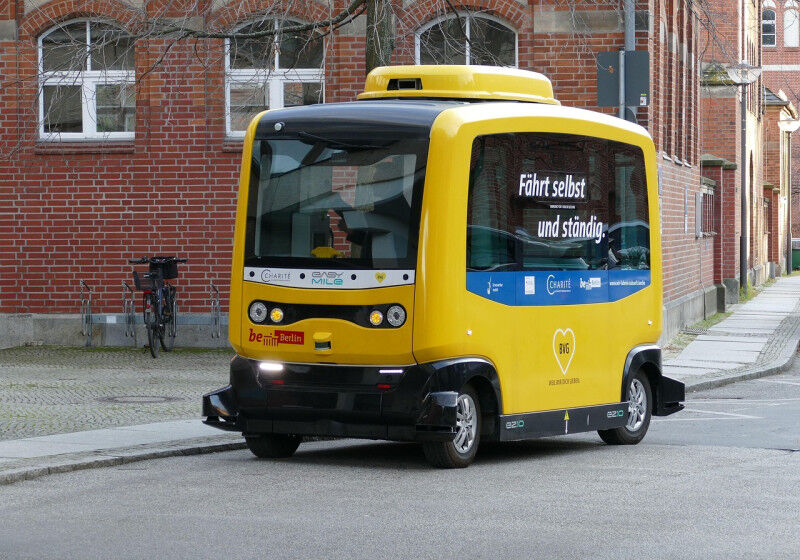
The year is 2040. You have just bought your first self-driving car: a fine piece of AI engineering. During your first drive, you feel like a child with a new toy. A few days later, your car hits a cyclist. Are you responsible for this, even though you weren’t behind the wheel? Has this actually been thought through?
In her research, AI scientist Lotte van Elteren asks critical questions about human limits in AI. "We are more concerned with finding answers through artificial intelligence than asking questions about it," she begins.
With her popular book Ik, AI (I, AI), she hopes to nudge readers in the right direction. It’s a book that makes you slam on the brakes and take a step back. A book that questions how we see human values, such as responsibility and justice, reflected in science. That raises questions about what AI actually is. Brain scientists, education experts, medical researchers, philosophers; she gives a voice to scientists from all corners who offer stimulating perspectives. "Actually, I hope that after reading my book, people will have more questions than they did before," says Van Elteren.
When is AI meaningful?
In her research, Van Elteren always asks what makes for a healthy interaction between humans and machines, and what we can expect from the human brain. "Ultimately, we want AI to support people, not replace them," says Van Elteren. That’s why we should not only ask questions about "how are we going to build that self-driving car," but also: "what will it do to the jobs of taxi and truck drivers?" "What new forms of social inequality can we expect?" "Who is responsible after an accident?" In short, who ultimately benefits from that vehicle? And can it help us grow on a personal level? That discussion needs to get started.
What do we mean by AI?
And to get the discussion going, a little refresher on what artificial intelligence is might help. "In very broad terms, AIs help to automate certain human tasks," explains Van Elteren. But she emphasizes that commercial parties are currently mainly familiarizing people with language models such as ChatGPT. "These parties create AIs because they can, because there is money to be made from them. But they are not necessarily the AIs that humanity is asking for," says Van Elteren. It is one reason why nine times out of ten we think of ChatGPT when we talk about AI. "With my book, I want to show that artificial intelligence is not a one-sided phenomenon, but a collection of techniques that all raise different questions," says Van Elteren.
Why are we so quick to believe the machine?
That is why she gives as many disciplines as possible a voice in Ik, AI . For example, she discusses how artificial intelligence in the medical world creates an automation bias : the tendency for people to trust AI because it seems to be right so often. "If a doctor sees thousands of perfect diagnoses using AI, it becomes increasingly difficult to critically contradict the machine in case 3001," explains Van Elteren. For this reason, one of the researchers in the book is working on so-called reflection machines: systems that force doctors to think twice. For example, by asking: "Would you make the same diagnosis if the patient were five years younger?" A small question with big consequences: it reminds people to take responsibility. Because let’s be clear, artificial intelligence has no experience, it consists only of statistics.
AI sometimes slows us down instead of speeding us up
Many people experience greater work pressure due to artificial intelligence. You think: "My colleagues are using it, so I have to as well." But Van Elteren cites a study from the book that reveals something remarkable: people who use AI, such as programmers, often end up spending more time on their tasks. That’s because you always have to check the AI’s work, and that checking takes time. This raises another problem: de-skilling.
If we leave a skill to AI for long enough, we forget how to do it. And it is precisely that critical eye we need to keep applying to the AI’s findings.
Keep your foot on the brakes
Van Elteren emphasizes that Ik, AI is not a manual on how to deal with artificial intelligence. It mainly helps you understand what is at stake and what to consider when using AI. "Even with the smallest bit of responsibility that you hand over to AI, you first have to understand what you are doing," concludes van Elteren. And to do that, we occasionally have to step on the proverbial brakes of the self-driving car.