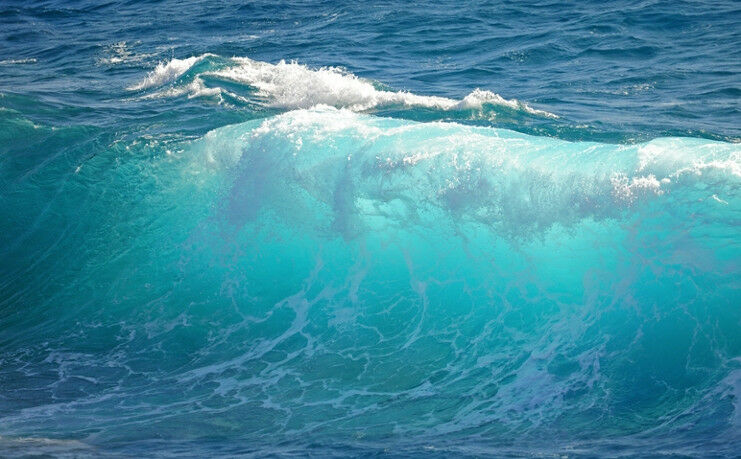
Water waves are localized excitations in the water, that in many aspects behave like particles, having velocities and energy, interacting, and so on. In materials, certain excitations can behave even more like particles, with all sorts of tunable properties: quasi-particles. Image: Flickr, by user Helen.
Water waves are localized excitations in the water, that in many aspects behave like particles, having velocities and energy, interacting, and so on. In materials, certain excitations can behave even more like particles, with all sorts of tunable properties: quasi-particles. Image: Flickr, by user Helen. The laws of quantum mechanics allow for the existence of 'quasi-particles': excitations in materials that behave exactly like ordinary particles. A major advantage of quasi-particles over ordinary particles is that their properties can be engineered. In a Nature Materials News & Views article this week, IoP physicist Erik van Heumen describes recent experiments where even the interactions between quasi-particles can be tuned. In recent years, the mathematical branch of topology , studying the shapes of things, and the physical branch of condensed matter physics , studying the behaviour of solids and fluids, have merged into an exciting new research field: that of topological materials .
OM DIT ARTIKEL TE LEZEN, MAAK JE ACCOUNT AAN
En breid je lezing uit, gratis en zonder verplichtingen.