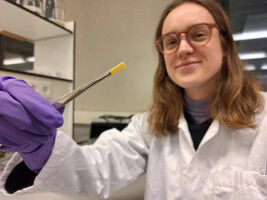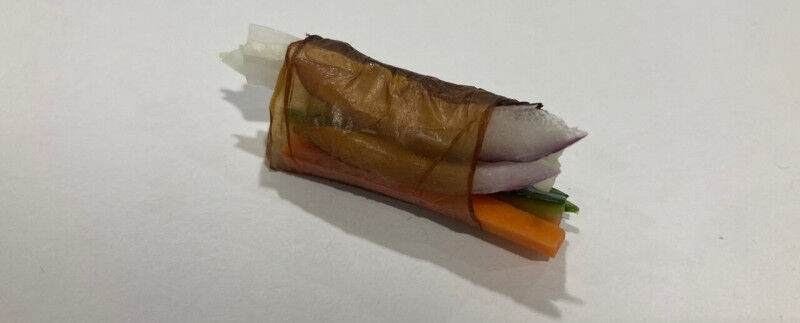
A wet film of cellulose, composed of cellulose-producing bacteria Komagataeibacter rhaeticus and Bacillus spores. Credits: Jeong-Joo Oh, Aubin-Tam Lab
These autonomously grown ELMs have a broad range of potential applications, such as detecting disease biomarkers and catalysing the breakdown of environmental pollutants. They might also function as self-healing composites. In the future, this latter application may be used for building materials, similarly to the self-healing concrete developed by TU Delft colleague Henk Jonkers. -Imagine asking bacteria to produce minerals that fill a crack in concrete, we could have self-repairing walls,- explains Jeong-Joo Oh, first co-author of the article. -Moreover, this approach could advance sustainability, since ELMs could replace fossil-based materials, like plastics, in our daily life.-Unique to these new materials is their on-demand programmable functionality. The ELMs can sleep, survive harsh conditions, and awaken on command. -Conventional living cells are able to perform useful functions like detecting biomarkers, but they only survive for a short time. We wanted a material we could use whenever we want to,- Oh says.
A wet film of cellulose under the microscope. The film is composed of cellulose-producing bacteria Komagataeibacter rhaeticus (labeled with a green fluorescent protein) and Bacillus spores (labeled with a red fluorescent protein). The images are made with a confocal microscope. Credits: Jeong-Joo Oh, Aubin-Tam Lab
Inspired by bacterial life cycle
-So, we looked for a way to keep the cells alive and got inspired by the life cycle of bacteria.- Certain bacterial species can switch into a dormant and metabolically inactive state, called a spore. Spores are extremely resistant to heat, dryness, and chemical stress. -This dormant state allows us to -wake upthe bacteria when the programmable functions are desired,- Oh says. -Using normal bacteria, you can only use the material within a few days or a week. We found out that with spores it still works after six months without losing functionality.-Two species collaborate
To fabricate the material, the scientists combined two bacterial species: Komogataeibacter rhaeticus and Bacillus subtilis. K. rhaeticus produces strong bacterial cellulose fibers that act as a protective physical barrier. Bacillus contributes its spore-forming capacity. The mixture yields a robust living material. By genetically modifying the bacterial sporessurface, the team added the needed functionality. Also, the genetic engineering step enhanced the sporesbinding to the cellulose.Step by step to real-world use
Before these materials appear in our daily life, the ELMs- performance and long-term stability should meet standards of existing materials. -At this stage, our work is at a proof-of-concept-level in the laboratory,- Oh notes. -To use these materials in concrete, for instance, they should match the strength of existing building materials. But the results are already very promising. Step by step, I hope to replace unsustainable materials with living, self-sustaining ones.-What are engineered living materials (ELMs)?
ELMs are innovative materials that use living cells to carry out their functions. The materials contain either natural or genetically engineered living cells. The cells are embedded in a supporting material made from natural or synthetic components. These materials can sense, respond, and even repair themselves, thanks to the biological activity of their embedded cells.Research into ELMs has grown rapidly since 2020, combining microbiology, materials science, and synthetic biology.
These engineered materials are based on a grown bacterial cellulose matrix hosting microorganisms.