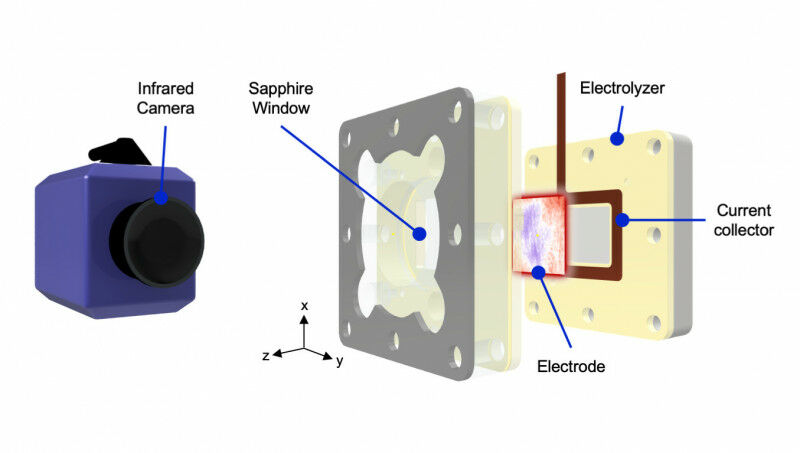
By using an infrared camera, the research team can detect the distribution of electrons on the electrode. Using these insights, they then designed a new way of delivering these electrons more evenly over the surface.
By using an infrared camera, the research team can detect the distribution of electrons on the electrode. Using these insights, they then designed a new way of delivering these electrons more evenly over the surface. With the ever-increasing interest in renewable energy, scientists are continuously searching for new technologies to store energy. CO2 electrolysis is a promising way to store energy whilst recycling carbon dioxide. By applying electricity, CO2 and water react and produce more complex molecules. A study published in Nature Communications lead by Hugo van Montfort at TU Delft has presented a new design of electrodes that improves the efficiency of CO2 electrolysis. The currently much used expanded Teflon electrodes (ePTFE) are porous, meaning that they have holes inside their structure.
TO READ THIS ARTICLE, CREATE YOUR ACCOUNT
And extend your reading, free of charge and with no commitment.