


news 2025
« BACK
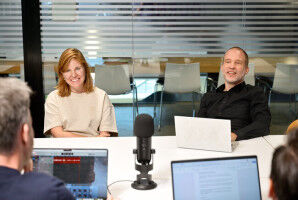 How these sleep scientists are embracing uncertainty
 Super-powered AI from Eindhoven helps doctors identify cancer and other diseases more quickly
 First Operating System for Quantum Networks
 Programming light for next generation communication systems
Computer Science
Results 1 - 10 of 10.
Health - Computer Science - 27.11.2025
A new look at sleep monitoring Two researchers from Eindhoven University of Technology and their team develop new ways to monitor sleep disorders. Sebastiaan Overeem and Merel van Gilst don't necessarily want more accuracy when gathering sleep data from patients with sleeping disorders. Instead, they want more room for uncertainty and ways to show that.
Health - Computer Science - 12.11.2025
TU/e makes new medical AI model available worldwide Researchers at Eindhoven University of Technology (TU/e) have developed a medical AI model that helps doctors identify abnormalities in CT scans at an earlier stage, enabling faster diagnosis of cancer and other diseases. The model was trained on more than a quarter of a million CT scans.
Computer Science - 13.10.2025
Assessing the health of the world’s long-span bridges from space
Satellite data can refine risk assessments and improve safety for critical infrastructure. A new method, published in Nature Communications, reveals that one-third fewer bridges are classified as high-risk when spaceborne monitoring availability is integrated into risk assessments. This enables infrastructure authorities to make better-informed maintenance decisions.
Computer Science - 17.09.2025
Material that listens: Twente breakthrough in speech recognition
Speech recognition without heavy software or energy-hungry processors: researchers at the University of Twente, together with IBM Research Europe and Toyota Motor Europe, present a completely new approach. Their chips allow the material itself to 'listen'. The publication by Prof. Wilfred van der Wiel and colleagues appears today in the prestigious scientific journal Nature .
Astronomy & Space - Computer Science - 06.06.2025
Self-learning neural network cracks iconic black holes
A team of astronomers led by Michael Janssen (Radboud University, The Netherlands) has trained a neural network with millions of synthetic black hole data sets. Based on the network and data from the Event Horizon Telescope, they now predict, among other things, that the black hole at the center of our Milky Way is spinning at near top speed.
Computer Science - 29.05.2025
More than ’just’ fun: Gaming for science
TU/e researcher explores the intersection of psychology, computer science and game design. Some unwind with a puzzle game on the couch, others dive into a shooter with friends. But as the newest research shows, games don't just entertain-they can offer insight and even sharpen the mind. Max Birk, an associate professor at Eindhoven University of Technology (TU/e), knows everything about it.
Computer Science - Physics - 12.03.2025
Breakthrough achievement paves the way for practical quantum internet applications Delft, The Netherlands: Quantum Internet Alliance (QIA) researchers at TU Delft, QuTech, University of Innsbruck, INRIA and CNRS recently announced the creation of the first operating system designed for quantum networks: QNodeOS.
Computer Science - Physics - 11.03.2025
Researchers at the University of Twente, in collaboration with the City University of Hong Kong, have designed a cutting-edge programmable photonic chip in a thin-film lithium niobate platform, an important material in photonics. Published in Nature Communications, this work paves the way for next-generation high-performance radar and communication applications.
Physics - Computer Science - 10.02.2025
’Hi-Fi’ sound in silicon chips
Researchers at the University of Twente solved a long-standing problem: trapping optically-generated sound waves in a standard silicon photonic chip. This discovery, published as a Featured Article in APL Photonics , opens new possibilities for radio technology, quantum communication, and optical computing.
Computer Science - Innovation - 31.01.2025
Bringing machine learning into the real world
We constantly hear about the -AI revolutionand the -digital transformation-. This is being driven by rapid advances from the field of machine learning (ML), such as those enabling autonomous vehicles, ChatGPT, DeepSeek and even predicting extreme weather events. But how do these innovations move from fundamental research to real-world impact? Geert-Jan Houben explores this question with the co-directors of the ELLIS Unit Delft: Frans Oliehoek and Jens Kober.


Advert