


news 2025
« BACK
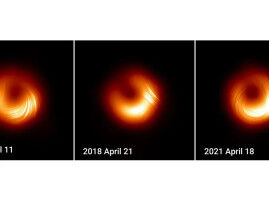 New EHT Images Reveal Unexpected Polarization Flips at M87*
 Novel ’Super-X’ design shows major advantages in handling hot exhaust of fusion energy
 Quantum researchers observe real-time switching of the magnet in the heart of a single atom
 Breakthrough in spintronic devices for ultra-thin quantum circuits
 Universe decays faster than thought, but still takes a long time
 TU Delft and Brown University pioneer technology for next-generation lightsails in space exploration
 Spinning, twisted light could power next-generation electronics
 Decoding material phase transitions with nanodrums
 First Operating System for Quantum Networks
 Programming light for next generation communication systems
 When thin becomes thinner
 Mars’ young northern ice cap and the surprises below its surface
Physics
Results 1 - 20 of 21.
Physics - Materials Science - 26.11.2025
Controlling quantum states in germanene
Researchers at the University of Twente and Utrecht University demonstrated for the first time that quantum states in the ultra-narrow material germanene can be switched on and off using only an electric field. The researchers were able to vary the electric field strength very precisely, causing the special 'topological' states in nanoribbons to disappear or appear.
Astronomy & Space - Physics - 16.09.2025
Multi-year observations by the Event Horizon Telescope have detected changing polarisation patterns in a supermassive black hole. The telescope was also able to better study the direction of a narrow beam of particles shooting out of the edge of the hole at the speed of light. The Event Horizon Telescope (EHT) collaboration has unveiled new, detailed images of the supermassive black hole at the center of the galaxy M87- known as M87*- revealing a dynamic environment with changing polarization patterns near the black hole.
Astronomy & Space - Physics - 15.09.2025
Astronomers spot mysterious gamma-ray explosion, unlike any detected before
Astronomers have detected an explosion of gamma rays that repeated several times over the course of a day, an event unlike anything ever witnessed before. The source of the powerful radiation was discovered to be outside our galaxy, its location pinpointed by the European Southern Observatory's Very Large Telescope (VLT).
Physics - Health - 15.09.2025
Novel NMR technique demonstrates biomarkers of rare epilepsy disease
Researchers from the Institute for Molecules and Materials (IMM) at Radboud University have demonstrated that non-hydrogenative parahydrogen induced hyperpolarization (nhPHIP),a special technique for enhancing NMR sensitivity, could successfully be employed for detecting biomarkers of the rare metabolic disease pyridoxine-dependent epilepsy (PDE).
Physics - Innovation - 05.09.2025
Dutch fusion researchers Kevin Verhaegh (TU/e) and Bob Kool (Dutch research institute DIFFER and TU/e) headed the work with a collaboration between the UKAEA and European EUROfusion research teams. International experiments at the UK fusion machine MAST Upgrade in Culham, led by Dutch researchers, demonstrate how the innovative 'Super-X' design offers major advantages in handling the heat exhaust of fusion energy machines.
Physics - 28.08.2025
Researchers from Delft University of Technology in The Netherlands have been able to see the magnetic nucleus of an atom switch back and forth in real time. They read out the nuclear -spinvia the electrons in the same atom through the needle of a scanning tunneling microscope. To their surprise, the spin remained stable for several seconds, offering prospects for enhanced control of the magnetic nucleus.
Physics - Chemistry - 12.08.2025
New way to study molecular collisions at cold temperatures
Researchers from the Institute for Molecules and Materials (IMM) at Radboud University have found a new way to study what happens when ammonia and hydrogen molecules collide at very low temperatures, around 1 kelvin, which is similar to the temperature in space. The experiment shows how ammonia and hydrogen molecules behave in extreme cold environments.
Physics - Electroengineering - 24.06.2025
Scientists from TU Delft have observed quantum spin currents in graphene for the first time without using magnetic fields. These currents are vital for spintronics, a faster and more energy-efficient alternative to electronics. This breakthrough, published in Nature Communications , marks an important step towards technologies like quantum computing and advanced memory devices.
Astronomy & Space - Physics - 12.05.2025
The universe is decaying much faster than thought. This is shown by calculations of three scientists at Radboud University on the so-called Hawking radiation. They calculate that the last stellar remnants take about 10^78 years (a 1 with 78 zeros) to perish. That is much shorter than the previously postulated 10^1100 years (a 1 with 1100 zeros).
Physics - Innovation - 01.05.2025
Steering sound with light: a game-changer for integrated photonics
By adding a sound-mediated way to control light to the toolkit of light-based chips, University of Twente researchers have pushed the boundaries of the technology. This opens up the possibility of making atomic clocks small enough to fit in satellites and drones, helping them navigate without GPS. Imagine having to find your way with only a compass and the stars and being handed a GPS.
Physics - Life Sciences - 08.04.2025
Redefining fluid control in microfluidics with magnetic artificial cilia
Tongsheng Wang defended his PhD thesis at the Department of Mechanical Engineering on April 8th. What if the next big breakthrough in biotechnology was inspired not by machines-but by microscopic hairs? Deep within the intricate world of microfluidics, where tiny volumes of fluid are manipulated with extreme precision, a new player is emerging: programmable magnetic artificial cilia.
Physics - Innovation - 03.04.2025
Invention from Twente brings quantum computer closer
An invention from Twente improves the quality of light particles (photons) to such an extent that building quantum computers based on light becomes cheaper and more practical. The researchers published their research in the scientific journal Physical Review Applied. "This technology is an essential part of any future photonic quantum computer." Quantum computers are at a tipping point: tech giants and governments are investing billions, but there are two fundamental obstacles: the quantity of qubits and the quality of these qubits.
Astronomy & Space - Physics - 24.03.2025
Researchers at TU Delft and Brown University have developed scalable nanotechnology-based lightsails that could support future advances in space exploration and experimental physics. Their research, published in Nature Communications , introduces new materials and production methods to create the thinnest large-scale reflectors ever made.
Physics - Innovation - 13.03.2025
Researchers have advanced a decades-old challenge in the field of organic semiconductors, opening new possibilities for the future of electronics. The researchers, led by the University of Cambridge and the Eindhoven University of Technology, have created an organic semiconductor that forces electrons to move in a spiral pattern, which could improve the efficiency of OLED displays in television and smartphone screens, or power next-generation computing technologies such as spintronics and quantum computing.
Physics - Materials Science - 12.03.2025
When water freezes into ice or boils into vapour, its properties change dramatically at specific temperatures. These so-called phase transitions are fundamental to understanding materials. But how do such transitions behave in nanomaterials? In Nature Communications , a team of scientists led by TU Delft presents new insights into the complex nature of phase transitions in magnetic nanomaterials.
Computer Science - Physics - 12.03.2025
Breakthrough achievement paves the way for practical quantum internet applications Delft, The Netherlands: Quantum Internet Alliance (QIA) researchers at TU Delft, QuTech, University of Innsbruck, INRIA and CNRS recently announced the creation of the first operating system designed for quantum networks: QNodeOS.
Computer Science - Physics - 11.03.2025
Researchers at the University of Twente, in collaboration with the City University of Hong Kong, have designed a cutting-edge programmable photonic chip in a thin-film lithium niobate platform, an important material in photonics. Published in Nature Communications, this work paves the way for next-generation high-performance radar and communication applications.
Physics - Electroengineering - 03.03.2025
If you start with a two-dimensional ribbon and make it narrower and narrower, when does it stop being a ribbon and start being a one-dimensional line? Scientists from Utrecht University and the University of Twente made one-atom-thick ultrathin nanoribbons consisting of germanium atoms. They have shown that this system exhibits amazing properties that can be useful, for example, in quantum computing.
Astronomy & Space - Physics - 26.02.2025
A group of researchers from TU Delft and the Institute for Planetary Research of the German Aerospace Center have been able to the determinate the Mars-s interior structure and the age of the large ice sheet covering its north pole. They have published their findings in Nature. The team used the same geophysical trick on Mars that geologists use here on Earth to: measure how large areas of land are deformed by the ice sheet that presses down on the planet itself.
Physics - Computer Science - 10.02.2025
’Hi-Fi’ sound in silicon chips
Researchers at the University of Twente solved a long-standing problem: trapping optically-generated sound waves in a standard silicon photonic chip. This discovery, published as a Featured Article in APL Photonics , opens new possibilities for radio technology, quantum communication, and optical computing.


Advert